
Why AI literacy is the new safety imperative
17 August 2026
Helping young people flourish in the digital world includes looking beyond simplistic narratives that portray online life as either inherently good or inherently bad. We must also focus on the authentic, everyday experiences of Generation Z to understand what enables them to thrive. As we enter a new era defined by the rapid rise of generative AI, our commitment to grounding our safety work in objective research is more critical than ever – and it will help to ensure that Snapchat remains a communications’ service centered on authenticity, connection, belonging and mattering.
Today, we are sharing some new insights from the fifth and final year of our Digital Well-Being Index (DWBI) study, specifically results centered on the evolving landscape of AI-generated content and its impact on interpersonal relationships.
For the last five years, Snap has conducted platform-agnostic research to help track and measure Generation Z's online psychological well-being. We conduct this survey to add to the global evidence base about young people's digital habits and practices, and it helps to raise awareness of emerging concerns so that parents, educators, technology companies, governments and civil society can work together more effectively to mitigate risk, reduce potential harm and prevent recurrence. The DWBI examines the experiences of 13-to-24-year-olds in six countries across the broader digital ecosystem, rather than focusing on any single platform, including Snapchat. The latest findings from Australia, France, Germany, India, the UK and the US include new insights into the creation and distribution of deepfake imagery among Generation Z.
Public discourse around AI often swings between unbridled optimism and deep concern. Rather than relying on either extreme, the latest DWBI findings provide an evidence-based view of how 13-to-24-year-olds in the six geographies are engaging with generative AI. Those findings reveal a complex and, at times, concerning picture of peer-to-peer interactions involving deepfakes. For instance:
Nearly one-third (30%) of respondents, aged 13 to 24, reported having created a deepfake of someone else
More than half (53%) of those who created a deepfake reported that the action resulted in “drama” or “conflict” within their social circles, and
While the majority used generative AI tools for creativity, fun and entertainment, more than a third (35% net) said the deepfakes they created were made with nefarious intent, specifically: to make someone look bad or to upset them (12%), in retaliation (12%) or to tease or harass another (11%).
Asked how they would respond specifically to a sexual deepfake of themselves, the vast majority (81% net) of minor-aged teens said they would talk to someone, namely a parent (65%), while seven in 10 Gen Z young adults (70%) said they would report it, with law enforcement (53%) and technology platforms (51%) their primary outlets. More than one in 10 minor teens (18%) and more than two in 10 18-to-24-year-olds (22%) said they would simply ignore it or not take any of the actions listed. The chart below outlines the proffered options for action.
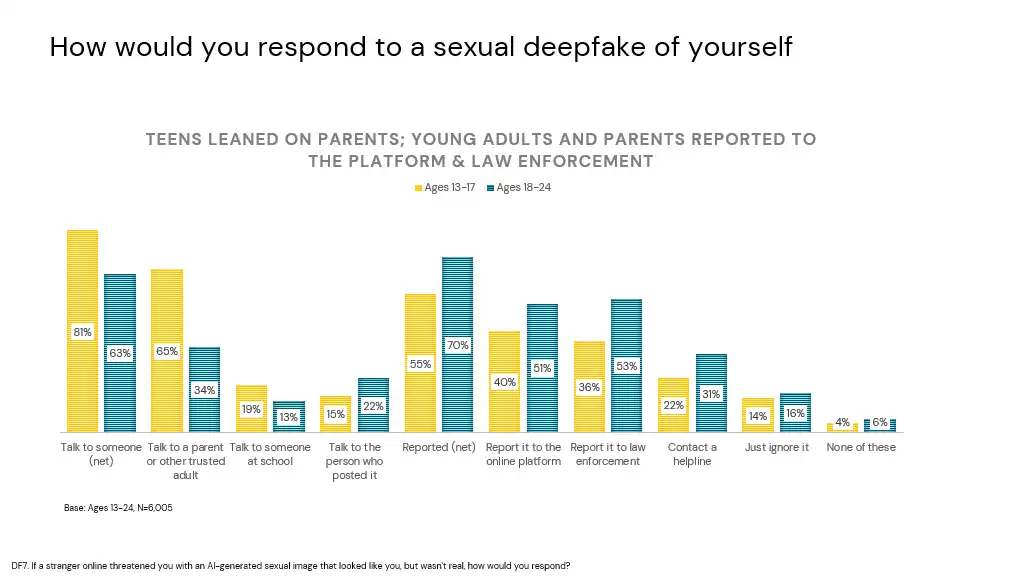
These findings underscore a critical truth: digital well-being in the 21st century requires more than traditional safety tools and resources; it demands deep, practical AI literacy. When 30% of young people report having created synthetic media involving their peers, that activity may have implications for personal relationships, reputations and an individual’s sense of control over how they are portrayed.
Accordingly, policy-focused conversations need to move away from fear-based reactions and toward a framework that embodies the “whole person” of youth online today. We can consider three core components:
AI Literacy: To help young people understand not just how to use AI, but the ethical and social consequences of creating content that may involve others without their consent.
Personal Control: To empower young people to recognise boundaries and to seek to maintain control over their own digital likenesses, and
Open Communication: To encourage teens, parents, educators and other trusted adults to have open and considered conversations about the quality versus quantity of digital interactions, recognising that any deepfake created even "as a joke" can have lasting impacts on others.
Incidentally, asked where and from whom they were learning to use AI tools safely and responsibly, eight in 10 13-to-24-year-olds (81% net) said they were self-taught. A quarter (27%) of 13-to-17-year-olds said they were learning from their parents, while teachers accounted for one in 10 of both teens’ (11%) and young adults’ (10%) knowledge bases.
The findings are part of Snap’s five-year study of Generation Z’s online psychological well-being across various platforms and mark the latest and final installment of our Digital Well-Being Index (DWBI), a measure of how teens (aged 13-17) and young adults (aged 18-24) are faring online in the six countries. We also survey parents of 13-to-19-year-olds about their teens’ online experiences. This latest poll was fielded between 11 May and 30 May 2026, and included 9,005 respondents across the three age demographics and six geographies. Full results, including the latest DWBI reading for each country and across all six combined, will be released on Safer Internet Day 2027 in February. We chose to make these AI-related findings available early given the ongoing global dialogue about many of these issues.
As we bring this five-year chapter of studying digital well-being to a close and evolve our research focus for the next number of years, our ecosystem-wide mission remains clear: to build online spaces where young people can learn, laugh and connect as safely and authentically as possible. The rise of deepfakes is a reminder that as technology evolves, our operational and educational efforts must evolve with it. By continuing to focus on literacy, resiliency and critical thinking, we can help ensure the next generation doesn't just "get by" online, but truly flourishes.
In support of these efforts, last month, Snap announced that wholly AI-generated videos will no longer be eligible for recommendation on Snapchat’s Spotlight feature. Indeed, as low-quality, repetitive, AI-generated content becomes increasingly common across online spaces, Snap wants Spotlight to remain a place where people can discover authentic creativity from real people. We also created a brief factsheet for parents and teens around AI-generated material. “Stop. Think. Could THIS Be AI?” is designed to spark conversations between teens, parents and other trusted adults about safe and responsible use of AI tools. We also collaborate with numerous other groups and organisations, and were the first to support the US Department of Homeland Security’s Know2Protect campaign, raising awareness of child sexual exploitation and abuse. Know2Protect published a primer on deepfakes here.
In the public policy realm, Snap supported the Take It Down Act, which went into effect in May of 2025, establishing a US federal framework for addressing non-consensual intimate imagery, including AI-generated content. The law makes it a federal crime to knowingly publish, or threaten to publish, intimate imagery without consent, whether the material is authentic or synthetically generated, and it requires covered platforms to provide a reporting process and remove reported content within 48 hours.
Similar concerns are reflected in the “No to Nudify” campaign launched on Safer Internet Day 2026, which brought together child-safety and civil society organisations, many of which are Snap partners and collaborators. The WeProtect Global Alliance, INHOPE, the Internet Watch Foundation, NCMEC, Child Helpline International, Offlimits and Safe Online called for a ban on AI nudification tools. The campaign holds that so-called “nudify” apps are not, in fact, harmless experimentation, but are instead used to create non-consensual sexualised images from ordinary photos, and are increasingly linked to harassment, coercion, sexual extortion and abuse affecting women, girls and children.
Snap also participates in practical cross-industry programmes designed to limit the spread of such material on Snapchat. We are members of NCMEC’s Take It Down programme for minors and SWGfL’s StopNCII effort for 18+, receiving and leveraging unique digital signatures, or “hashes,” to help detect duplicate intimate imagery and remove content that violates our rules. These efforts matter because they focus not only on initial detection, but on preventing the recirculation of known intimate imagery and sexual deepfakes once they begin to spread.
– Jacqueline Beauchere, Global Head of Platform Safety, Snap Inc.