
New Snap research: Gen Z remains a target for online sextortion, but signs of progress
October 29, 2024
New Snap research: Gen Z remains a target for online sextortion, but signs of progress
October 29, 2024
Our Continued Efforts to Thwart Online Child Sexual Exploitation
Over the past three years, the online risk landscape has witnessed a staggering spike in “sextortion” – scams that deceive primarily teens and young adults into sharing intimate imagery that quickly turn to blackmail. While new industry-wide research shows the risks continue, there are encouraging signs that efforts to thwart offenders and educate potential targets are taking hold. (Snap Inc. commissioned this research, now in its second year, but it covers Generation Z teens’ and young adults’ experiences across online platforms generally, with no specific focus on Snapchat.)
Nearly one-quarter (23%) 1 of the 6,004 13-to-24-year-olds surveyed in six countries 2 across all platforms and services said they were victims of sextortion. Meanwhile, more than half (51%) reported having been lured into certain online situations or having engaged in risky digital behaviors that could have led to sextortion. These include “grooming 3” (37%), being “catfished” (30%), being hacked (26%), or sharing intimate imagery online (17%). Importantly, ongoing awareness-raising and educational campaigns by multiple groups appear to be resonating such that fewer “targeted” young people are actually falling victim to these schemes.
Online catfishing occurs when criminals pretend to be someone they’re not to entice a target into sharing personal information or producing sexual imagery. Hacking usually involves an offender gaining unauthorized access to a target’s devices or online accounts to steal intimate photos or personal information. For the most part, in both scenarios, the videos, photos, or other private information acquired is then used to blackmail the victim into acceding to the perpetrator’s demands in supposed exchange for not releasing the compromising imagery to the person’s family and friends.
Voluntarily sharing digital intimate imagery among young people is largely regarded as sexual exploration in the 21st century and that characterization is backed by research. But the practice remains a key risk vector for sextortion and other potential harms stemming from misrepresentation and falsehoods. Latest findings show that of the 17% of respondents who admitted to sharing or distributing intimate imagery, 63% said they were lied to by the perpetrator and 58% reported losing control of the material once sent. Those under age 18 who shared intimate imagery were particularly vulnerable: 76% said they were lied to by the abuser and 66% said they lost control of the imagery.
“Teens want stronger regulation and systems of redress to enhance their safety online,” said Professor Amanda Third, Co-Director of the Young and Resilient Research Centre at Western Sydney University, who led a parallel study 4 in partnership with Save the Children, with funding from the Tech Coalition. “They want children and adults to be better educated. And they are calling on platforms to harness the power of artificial intelligence and other emerging technical capabilities to ensure that the digital spaces they frequent are free from bad actors, inappropriate content, and not just safe but optimal for them.”
“Thoughtful, age-appropriate design that can support children to identify bad actors, provide real-time suggestions for how to respond to inappropriate interactions, and connect them with high-quality information and help-seeking pathways are urgently needed to help combat the steep rises in sexual extortion online,” she added. Prof. Third is also a member of Snap’s Safety Advisory Board.
Other key results
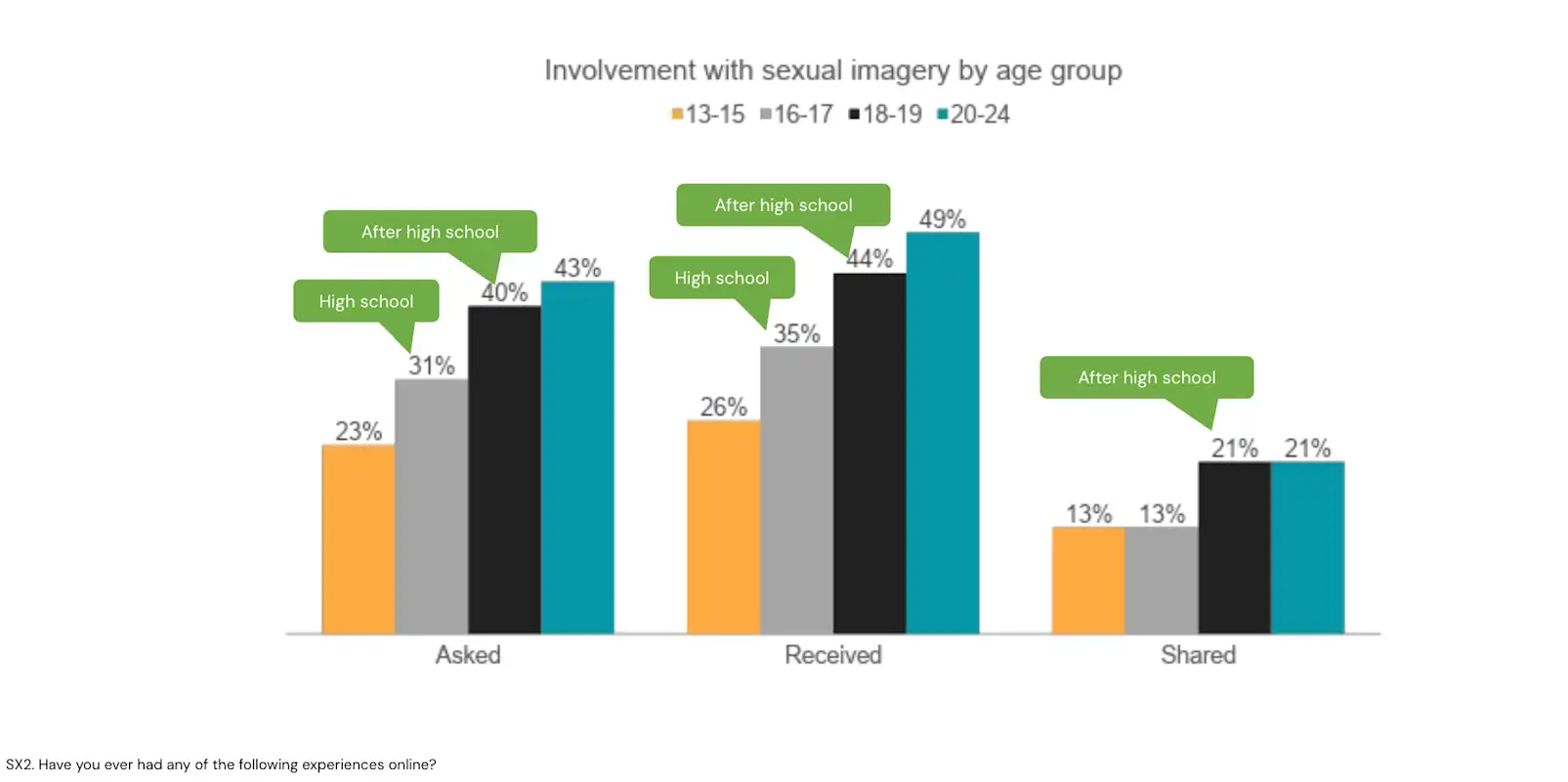
Nearly half (47%) of Gen Z respondents said they had been involved with intimate imagery at some point: 35% were asked to share sexual photos or videos, and 39% said they received imagery.
Involvement with sexual imagery increased with Gen Z’s age.
Among 13- to 15-year-olds, roughly a quarter had ever been asked to share (23%) or received (26%) intimate imagery. Just 13% admitted to having shared it.
Among 16- and 17-year-olds, those percentages jumped to 31% (asked) and 35% (received), while still only 13% admitted to having shared sexual imagery.
Percentages rose yet again among 18- and 19-year olds and 20- to 24-year olds, topping at 43% (asked) and 49% (received) among this oldest cohort. (See chart for details).
The research is part of Snap’s ongoing study of digital well-being – a measure of Gen Z’s online psychological health. While Snap sponsored the research, it looks across all platforms, services, and devices, with no specific focus on Snapchat. Conducted from June 3 through June 19 in Australia, France, Germany, India, the UK, and the U.S., a total of 9,007 people participated in the study, including 3,003 parents of 13- to 19-year-olds, who were asked about their teens’ exposure to online risks. We will make additional findings available between now and February when we will release the full results in conjunction with international Safer Internet Day 2025. At that time, we will also announce the Year Three reading of Snap’s Digital Well-Being Index.
We are making these latest sextortion deep-dive results available today to coincide with our participation in the Technology Coalition’s virtual Multi-Stakeholder Forum on financial sextortion impacting minors. As explained further below, Snap has been combating sextortion since 2022. Undertaking this cross-platform research is one way to better understand and work to address the risks.
“Research like this shines a critical light on the threats young people face online, but it also underscores the power of collaboration between industry, governments, and civil society to address these challenges,” said Sean Litton, President & CEO of the Tech Coalition. “We are honored to have Snap present this new research at the Tech Coalition’s Global Multi-Stakeholder Forum on Financial Sextortion. By raising awareness and taking collective action, we can create safer digital spaces for children worldwide.”
Perpetrators’ demands and victims’ actions
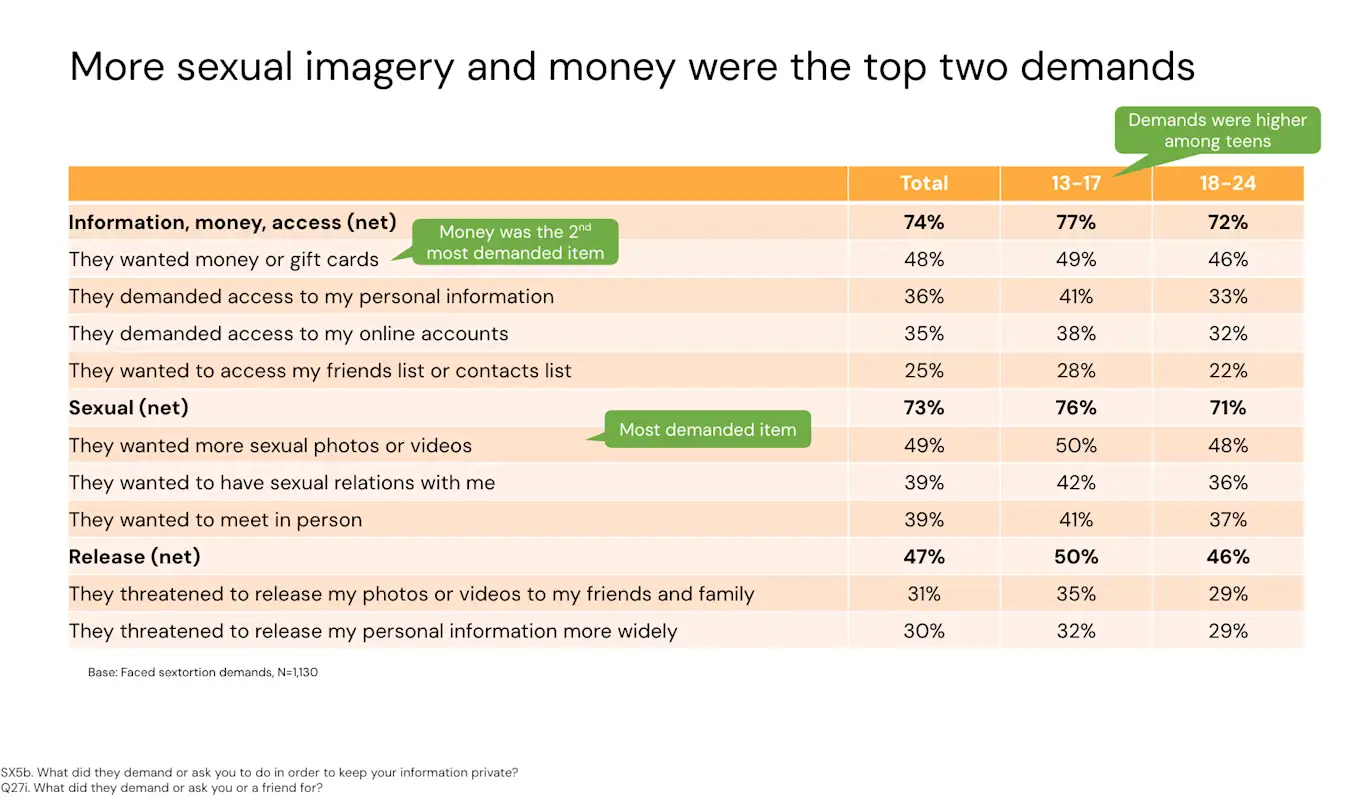
Of those Generation Z teens and young adults who fell victim to sextortion (23%), sexual photos / videos and money were extorters’ top two demands, with nearly half pressing for more sexual imagery, money, or gift cards. Consistent with last year’s findings, other demands included wanting to meet in person (39%), wanting to engage in sexual relations (39%), demanding access to personal information (36%) or to the victim’s accounts (35%), and demanding access to the victim’s friends and contact lists (25%). In nearly a third of instances, the perpetrator threatened to release the imagery to the respondents’ family and friends and, in almost another third, offenders threatened to release personal information more widely. In all cases, demands made of minor-aged teens were higher than those made of Gen Z young adults. (See chart for details).
On the good news front, a healthy 85% of victims said they took some action in response to sextortion, up from 56% 5 last year. Broadscale net actions included asking for help (70%) from a parent, teen, or other trusted adult; reporting the incident (67%); taking other protective actions (64%) like blocking the perpetrator – the single most common action; updating security measures on accounts, and even closing accounts. Still, 18% said they kept the incident to themselves or didn’t do anything (8%),
As we at Snap seek to turn the tide on reporting and continue to encourage upstanding engagement among teens, young adults, and all members of our community, we are very interested in data pertaining to victims who have reported to platforms and law enforcement. Our latest study shows 36% of Gen Zers reported to the relevant platform, while 30% reported to a hotline or helpline, and 27% contacted law enforcement. All of these reporting percentages are up from 2023.
Snap’s ongoing commitment
Snap has been fighting back against sextortion on our platform for nearly two years. We’ve always made vital blocking and reporting tools available. Last year, we added a dedicated sextortion reporting reason, as well as new in-app awareness-raising and educational resources. This year, we followed with updated in-app warnings to alert teens and young people to possible suspect friend requests. We also routinely add new functionality to our parental supervision suite of tools, Family Center, which is designed to spark conversations between teens, parents, caregivers, and other trusted adults about staying safe on Snapchat and online generally.
Anecdotal feedback indicates young people are more aware of the risk of sextortion and that our in-app warnings are helping. “Just that moment's pause for thought could make a really big difference,” noted one European NGO leader, quoting a teen.
Wiping out sextortion risk before it can even take hold remains our primary objective, but these are whole-of-society issues requiring active engagement from a range of stakeholders and sectors – technology platforms and services, law enforcement agencies, parents, caregivers, educators, and young people themselves. We appreciate the ongoing collaboration and engagement from the Tech Coalition and its members, the National Center for Missing and Exploited Children, Thorn, our Safety Advisory Board members, and others, and we hope this latest installment of cross-platform research provides fresh insights for many. We look forward to additional opportunities for research, learning, and investment, as we all seek to protect people from sextortion and other potential online risks.